Author: news-admin

  • Myanmar Agrees to Take Back 5,000 Rohingya from Malaysia, Anwar Says – Rohingya Khobor

    Myanmar Agrees to Take Back 5,000 Rohingya from Malaysia, Anwar Says – Rohingya Khobor


    by Hafizur Rahman

    July 29, 2026

    Myanmar has agreed to take back an initial group of 5,000 Rohingya refugees currently living in Malaysia following bilateral negotiations, Malaysian Prime Minister Anwar Ibrahim said on Wednesday.

    Anwar announced the purported agreement during an event in Chennah, Jelebu. He said Myanmar had previously refused to accept Rohingya refugees but had changed its position following diplomatic engagement with Malaysia.

    “People ask to send them back, but send them back where? Send them to Myanmar—previously, they did not want to accept them,” Anwar said.

    “But due to the good relations between Malaysia and Myanmar, they have now agreed to take in 5,000 Rohingya refugees first from Malaysia,” he added.

    Anwar did not identify the Myanmar authority with which the purported agreement was reached. He also provided no timeline, selection procedure or information about whether the refugees concerned would return voluntarily.

    Myanmar authorities had not publicly confirmed the agreement at the time of publication.

    The announcement therefore does not establish that a formal repatriation arrangement has been signed or that returns are imminent. It also remains unclear where the Rohingya would be sent, who would guarantee their safety and whether they would receive citizenship, freedom of movement and access to their original homes and land.

    Anwar also claimed that Myanmar had agreed to receive 300,000 Rohingya refugees from Bangladesh. However, he did not provide details or clarify whether this referred to a new agreement or refugees whose names had previously been submitted to Myanmar for verification.

    In April 2025, Bangladesh said Myanmar had confirmed that 180,000 Rohingya on previously submitted lists were eligible for return, while another 70,000 remained under review. No repatriation followed that announcement.

    Previous attempts to begin repatriation from Bangladesh in 2018 and 2019 failed after Rohingya refugees refused to return without credible guarantees of citizenship, security and fundamental rights.

    Conditions inside Rakhine State have since deteriorated further. Fighting has displaced additional Rohingya civilians, while the Arakan Army now controls much of northern Rakhine, including areas along the Bangladesh border. This raises further questions about how any return agreement negotiated with Myanmar authorities could be implemented on the ground.

    Anwar said Malaysia would continue discussions with Myanmar in search of a longer-term response to the refugee crisis.

    The announcement comes amid growing pressure on Rohingya refugees in Malaysia. Earlier this week, Malaysian authorities detained more than 100 Rohingya asylum-seekers, including women and children, after they gathered outside UNHCR’s Kuala Lumpur office seeking protection.

    Although police later confirmed that members of the group held valid UNHCR documents and were being temporarily accommodated, the incident intensified concerns about increasing enforcement pressure and hostility directed at Rohingya communities.

    Malaysia hosts approximately 126,000 Rohingya registered with UNHCR. The country is not a party to the 1951 Refugee Convention and does not formally recognise refugees under domestic law, leaving even documented asylum-seekers vulnerable to arrest and immigration detention.

    Anwar has also warned that authorities will take action against refugees who violate Malaysian law or disrupt public order. However, refugee status or lack of immigration documentation does not remove the requirement that any return be voluntary, informed and conducted with safeguards against persecution.

    For Rohingya refugees, repatriation cannot be treated simply as the physical transfer of people to Myanmar. Any credible process would require consultation with the refugees themselves, independent monitoring, protection against forced return, restoration of citizenship and legal identity, freedom of movement, access to homes and land, and guarantees against renewed persecution.

    Until Myanmar confirms the agreement and these essential details are disclosed, Anwar’s announcement remains a diplomatic claim rather than an operational repatriation plan.


    Source link

  • What Land Restitution Would Actually Require for Rohingya Return – Rohingya Khobor

    What Land Restitution Would Actually Require for Rohingya Return – Rohingya Khobor


    by Arafat Hossain

    Before 2017, Myo Thu Gyi village tract in northern Arakan contained more than 800 Rohingya homes, shops, markets and mosques. By 2018, more than 411 acres had been burned and flattened, and a large Border Guard Police base had been built on the site. This was not an isolated case. An investigation by the Independent Investigative Mechanism for Myanmar found that, in seven village tracts it examined, Rohingya homes and properties were destroyed after residents fled, before security installations were constructed on the cleared land.

    Across Maungdaw, Buthidaung and Rathedaung townships, UN satellite analysis identified 411 settlements damaged or destroyed between August 2017 and November 2018. Approximately 40,600 structures were destroyed. Mosques, cemeteries, farmland, homes and businesses were not merely abandoned in the chaos of displacement. In documented cases, they were demolished, appropriated and repurposed through coordinated action involving the Myanmar military, Border Guard Police, government authorities and private companies. The IIMM’s findings establish that the assault on the Rohingya was also an assault on their physical and territorial existence.

    This fact exposes a fundamental weakness in the international discussion of Rohingya repatriation. Diplomats repeatedly speak of returning refugees to Myanmar, but rarely answer the question on which any meaningful return depends: return to what?

    For many Rohingya families, the village to which they are expected to return may no longer exist. Their land may be occupied, converted into a security installation, allocated to others or administratively reclassified. Village names and boundaries may have been altered, while the institutions that would ordinarily adjudicate ownership remain neither independent nor accessible to Rohingya claimants.

    Crossing the Bangladesh–Myanmar border cannot, by itself, constitute return. Return requires restoration of the rights that made a place home: the right to possess land, rebuild a house, cultivate fields, inherit property, use communal resources and live without the permanent threat of renewed expulsion.

    The international community therefore needs to move beyond the language of repatriation and establish a concrete framework for housing, land and property restitution. Without such a framework, repatriation could place Rohingya families in transit centres, segregated settlements or displacement sites inside Myanmar while presenting their movement across the border as a durable solution.

    Restitution must begin before repatriation

    The UN Principles on Housing and Property Restitution for Refugees and Displaced Persons, commonly known as the Pinheiro Principles, recognise the right of displaced people to recover housing, land and property of which they were unlawfully deprived. Where actual restoration is factually impossible, an independent and impartial tribunal may determine appropriate compensation. The principles also establish that restitution should be treated as the preferred remedy for displacement and dispossession, rather than being reduced automatically to cash compensation.

    For the Rohingya, this means that the land-claims process cannot wait until refugees have returned. Requiring a claimant to enter an insecure territory before being permitted to assert a property right would make access to justice contingent upon exposure to the very authorities or armed actors whose conduct may be under challenge.

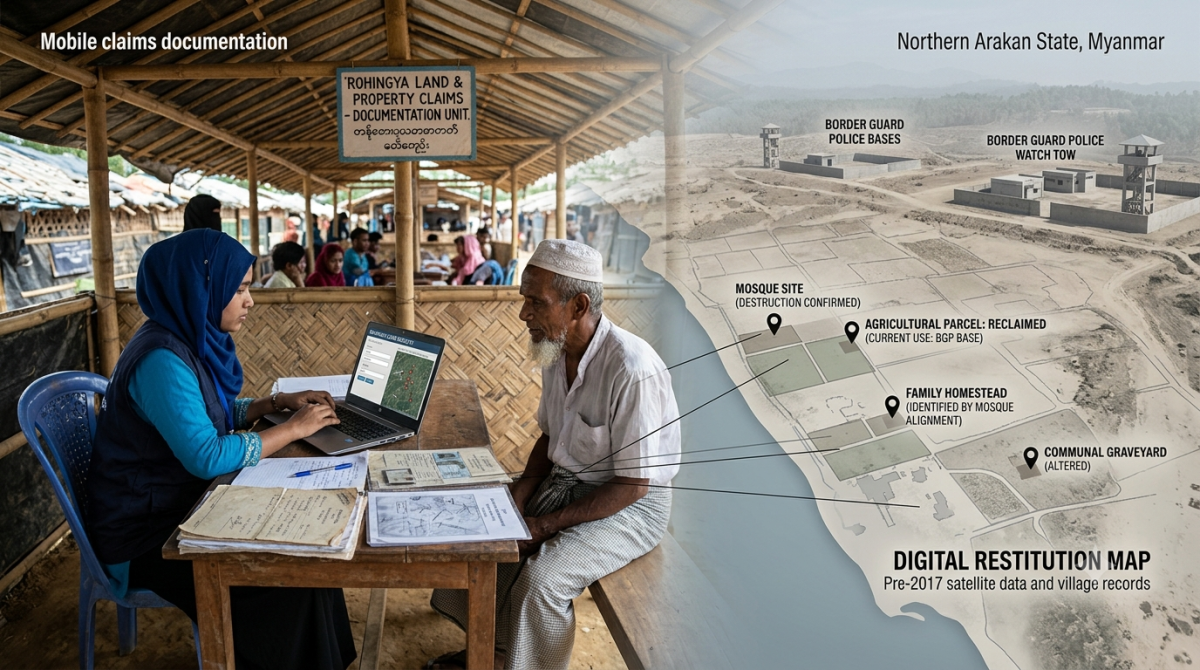
    Mobile claims offices should therefore be established in the refugee camps in Bangladesh. These offices could document the village of origin of each family, the location of its homestead, the approximate area of agricultural land it possessed and the surrounding physical features by which the land can be identified. Nearby mosques, cemeteries, ponds, canals, roads, markets, schools, forests and hills may be crucial in reconstructing locations where formal plot markers and administrative records have disappeared.

    This documentation should form the basis of an independent and verifiable Rohingya Land and Village Registry for northern Arakan. The registry should include pre-2017 village boundaries, household-level homesteads, agricultural parcels, ponds, grazing areas, customary forest-use areas, markets, mosques, madrasas, schools, cemeteries, village roads and other communal resources. It should also record the current use of each property, whether a military installation or new settlement has been constructed there and what evidence supports the original claim.

    This would involve more than producing a cadastral map. Displacement may have been followed by the alteration of maps, place names, land classifications and administrative boundaries. Historical government records should therefore be compared with pre-2017 satellite imagery, UNOSAT destruction mapping, village maps maintained by humanitarian organisations, land-tax receipts, household lists, mobile-phone photographs and testimony from former village administrators, neighbours and community elders.

    A refugee family cannot give informed consent to return without knowing the condition of its land, who currently occupies it and whether there is a credible process for restoring its rights. Consent obtained while such information is withheld cannot meaningfully be described as voluntary. UNHCR itself defines voluntary repatriation as the free and informed return of refugees in safety and dignity and identifies housing and property restitution as part of the conditions required for return.

    Formal deeds cannot be the only admissible evidence

    Decades of discrimination weakened the ability of Rohingya families to acquire, update and preserve formal land documents. Denial of citizenship, restrictions on movement, discriminatory household registration and limited access to government offices constrained their capacity to formalise property rights. When families fled in 2017, documents were burned with their homes, left behind or lost on the journey to Bangladesh.

    If modern title deeds are made the exclusive form of admissible evidence, the restitution mechanism will reproduce the discrimination that made such documents difficult to obtain in the first place.

    Land-tax receipts, household lists, agricultural permits, certificates issued by former village administrators, inheritance testimony, corroborating statements from neighbours, historical satellite images, family photographs, hand-drawn village maps, evidence of long-term customary possession and physical landmarks such as mosques, cemeteries, roads and ponds should all be accepted as potential evidence.

    Nor should claimants face the same burden of proof used in ordinary civil litigation. Where state authorities or armed actors participated in the destruction of records, it would be perverse to demand mathematically precise descriptions of every plot from the victims of that destruction.

    A restitution system could instead establish a rebuttable presumption of prior possession. When a family presents credible evidence that it possessed or used a particular property before displacement, the claim should be presumed valid unless a competing party produces stronger contrary evidence. This would not eliminate evidentiary scrutiny. It would place the burden where justice requires it, rather than allowing the destruction of evidence to benefit those responsible for dispossession.

    The IIMM has explicitly recognised these evidentiary barriers and recommended reliance on material extending beyond formal documentation, including geospatial imagery, witness testimony and other evidence of destruction and dispossession.

    An independent Land Claims Commission is essential

    Restitution cannot be entrusted to Myanmar’s existing land administration. The administrative system that denied Rohingya citizenship, controlled their movement and enabled land to be reclassified or allocated cannot reasonably be expected to adjudicate the consequences of those policies impartially.

    Myanmar’s Farmland Law and Vacant, Fallow and Virgin Lands Management Law give administrative bodies extensive authority over land registration and dispute resolution. Such arrangements create a risk that land belonging to displaced people will be treated as “vacant,” “fallow” or “unused.” But land from which residents were expelled through mass violence is not abandoned land. Treating forced displacement as abandonment converts the consequences of a crime into the legal basis for a new property right.

    A special and independent Rohingya Land Claims Commission is therefore required. One division should receive claims, digitise documents, interview claimants and verify maps, satellite evidence and testimony. An independent tribunal should adjudicate disputed ownership, inheritance conflicts, military occupation, company concessions and claims involving secondary occupants. Its decisions should be legally binding and subject only to a limited, time-bound appeal process.

    An enforcement division would then survey boundaries, restore possession, issue titles or legally protected occupancy certificates, arrange compensation and ensure implementation of tribunal decisions.

    The commission’s decisions must not be subject to veto by the Myanmar military, Border Guard Police, local administrative authorities or any de facto armed authority. Claimants should have access to free legal assistance, Rohingya-language forms and interpretation, witness protection and written decisions. A public database of decisions should be maintained while confidential personal information is protected.

    A commission without Rohingya authority would lack legitimacy

    A mechanism established for Rohingya claimants cannot rely on symbolic consultation. Rohingya representatives must hold substantive decision-making roles at every stage.

    The commission should include Rohingya legal specialists, women representatives, elders familiar with customary landholding, former village administrators, youth representatives, diaspora documentation specialists and representatives of claimants living in Bangladesh. International experts may provide technical support, but they cannot substitute for the community’s knowledge of village geography, inheritance practices, customary possession and local history.

    No rule should require a refugee to return to Myanmar before filing a claim. Physical return, property restitution and compensation are related but legally distinct. A person’s inability or unwillingness to return under unsafe conditions does not extinguish ownership or inheritance rights. Family members living in Bangladesh or elsewhere must therefore retain the right to submit and pursue claims.

    Women’s property rights require particular protection. Many Rohingya families have lost male relatives to killing, disappearance, detention or separation. If applications are recognised only in the name of a male “household head,” widows, daughters, female-headed households and survivors of sexual violence will again be excluded from property ownership.

    Women must be recognised as independent claimants. They must be permitted to submit claims without the approval of a male guardian and to assert inheritance, marital-property and occupancy rights. Confidential hearings and gender-sensitive evidentiary procedures will be necessary, particularly where the claimant’s displacement or loss of documents is connected to sexual violence or the death of family members.

    Military bases and new settlements cannot simply be legalised

    One of the most difficult questions concerns military and police facilities, roads, government buildings and new settlements constructed on former Rohingya land.

    The location and construction date of every military installation, Border Guard Police base, road, helipad, government facility and commercial concession on former Rohingya land should be disclosed. Where a facility was constructed by taking advantage of the forced displacement that began in 2017, it cannot be retrospectively legitimised as an ordinary public-purpose acquisition.

    Where possible, the installation should be removed and the original property returned. If restoration is genuinely impossible in an exceptional case, the claim of public necessity must be independently assessed. The claimant should receive land of equivalent quality, full compensation and reparation for lost use and income, based on informed consent. Military convenience cannot be accepted as proof of impossibility.

    Secondary occupation also requires careful treatment. It would be unjust to classify every non-Rohingya family currently living on former Rohingya land as a criminal occupant. Some may themselves be poor, displaced or resettled there through state policy. Summary eviction could produce another cycle of dispossession and communal hostility.

    Due process and state-funded alternative housing should therefore be provided to vulnerable secondary occupants. Yet their vulnerability cannot extinguish the rights of the original Rohingya owner. The responsibility of public authorities is not to force two impoverished communities to compete over the consequences of state-engineered dispossession. It is to restore the original claimant’s rights while providing a lawful alternative for occupants who are not directly responsible for the original seizure.

    Restitution, reconstruction and compensation are separate remedies

    Restitution means restoring the original land or property right. Reconstruction means rebuilding destroyed houses, schools, mosques, wells, roads and community infrastructure. Compensation addresses property that genuinely cannot be restored or losses that remain after restitution has taken place.

    These remedies must not be collapsed into one another. A family may recover its land but still require support to rebuild its home. Agricultural land may be returned, but the family may remain entitled to compensation for destroyed crops, trees and livestock, years of lost income and the deterioration of the soil. The destruction of a cemetery, mosque or entire village network cannot be remedied through an individual cash payment alone.

    Compensation should not be calculated solely according to the present market value of the land. The assessment must include destroyed homes and businesses, lost crops, trees and livestock, years of lost use and income, damage sustained during displacement and the loss of communal and cultural heritage.

    Public acknowledgment, memorialisation and guarantees that the same forms of dispossession will not recur are also elements of reparative justice. The UN Basic Principles and Guidelines on the Right to a Remedy and Reparation distinguish among restitution, compensation, rehabilitation, satisfaction and guarantees of non-repetition. A credible Rohingya framework should incorporate all of these rather than presenting a one-off payment as complete justice.

    Discriminatory land transfers must be frozen and reviewed

    Before claims are adjudicated, a moratorium should be imposed on the transfer, lease, concession, reclassification and allocation of conflict-displaced Rohingya land. Transactions conducted after the 2012 displacement and the 2017 military campaign require independent review.

    Any classification of Rohingya property as vacant or unused because its owners were forcibly displaced should be cancelled. Military and corporate concessions should be audited, and fraudulent or unlawfully obtained titles annulled. Decisions of the restitution commission must take precedence over subsequent discriminatory registrations or conflicting administrative allocations.

    Private companies cannot be excluded from accountability. The IIMM identified the involvement of corporations, local companies and associated individuals in providing machinery and labour for demolition and construction on seized land. Investigators should disclose which companies received contracts, who their beneficial owners were and what they knew about the origins and use of the land.

    Depending on the evidence, responsible companies and individuals could be required to contribute to a restitution fund, face civil liability or targeted sanctions, and be investigated for possible participation in serious international crimes. The private execution of a state contract does not erase responsibility when the work contributes directly to the destruction and appropriation of civilian property.

    Responsibility now extends beyond the junta

    The political and military geography of northern Arakan is no longer the same as it was in 2017. The Arakan Army and its political wing, the United League of Arakan, exercise de facto control over much of the region, while other areas remain contested. A restitution framework directed exclusively at Myanmar’s military authorities would therefore be detached from present territorial realities.

    Whichever authority controls a territory must protect the housing, land and property rights of the population living there. The absence of international recognition does not release a de facto armed authority from its responsibilities toward civilians.

    The AA/ULA should provide a clear written recognition of Rohingya identity and of Rohingya rights to village residence, property ownership, citizenship, freedom of movement and participation in local administration. Such commitments are especially necessary given recent documentation of killings, forced labour, arbitrary detention, severe movement restrictions and other abuses against Rohingya civilians in areas affected or controlled by the AA.

    Any operational framework must answer several practical questions: who will provide access to land records; who will remove military occupation; who will enforce tribunal decisions; and which security arrangement will protect claimants and returnees? If junta-issued records conflict with new records created under AA/ULA administration, the decision of the independent claims commission should prevail.

    A title is meaningless without citizenship and security

    Restoring ownership on paper will achieve little if a Rohingya claimant cannot travel to the land, live there, cultivate it, transfer it or seek legal protection against another expulsion. That would amount to paper restitution.

    Effective restitution requires citizenship or a secure and equal legal status, freedom of movement, protection from arbitrary arrest, an end to armed checkpoints and paid travel permissions, a prohibition on forced labour, vetting of security personnel, an independent complaints mechanism, humanitarian access and sustained international monitoring.

    A stateless person may possess a title certificate but remain unable to register, inherit, transfer or defend the property before a court. Land restitution therefore cannot be separated from citizenship, legal identity and equal protection under the law.

    International monitoring will need to continue beyond the initial return process. Satellite imagery can identify new military installations, village demolitions, road construction, settlement expansion and encroachment. Field monitors must also verify transfers of possession, returnee access, intimidation, recognition of women’s ownership and implementation of tribunal decisions.

    Monitoring that ends when refugees cross the border would record movement, not durable return.

    Repatriation language must be converted into enforceable conditions

    Four terms recur in almost every diplomatic statement concerning Rohingya repatriation: safe, voluntary, dignified and sustainable. Too often, they function as diplomatic decoration. Land restitution gives each term a concrete meaning.

    Safe return means that a person can reach and occupy their land without an armed threat. Voluntary return means that refugees know where they are returning, what has happened to their property and what remedy is available before deciding. Dignified return means they will not be confined indefinitely in camps or transit centres but will return to their ancestral communities as rights-bearing residents. Sustainable return means that they will have homes, agricultural land, livelihoods, social institutions and inheritable rights for future generations.

    Without these conditions, the number of people transported across the border may increase, but the Rohingya crisis will not be resolved. Refugees would instead be sent into a territory where their identity remains contested, their land is occupied and their security depends on authorities that are not independently accountable.

    The first question concerning Rohingya repatriation is therefore not how many people can be sent back. It is where they will return, under what legal rights and under whose security guarantees.

    No repatriation can constitute genuine return without rebuilding villages, establishing an independent claims system, reviewing military and commercial occupation and securing citizenship and freedom of movement.

    Returning to one’s homeland means more than crossing a border. It means recovering a recognised and enforceable relationship with the land. Without restitution, repatriation would not resolve displacement. It would construct a new geography of control and confinement for the Rohingya.

    References

    1. Independent Investigative Mechanism for Myanmar. “The Destruction and Dispossession of Rohingya Land and Property During the 2017 Clearance Operations—Public Summary.” 29 September 2025.
    2. Independent Investigative Mechanism for Myanmar. “Myanmar Mechanism Report Identifies Entities Benefitting from Destruction and Dispossession of Rohingya Land and Property in 2017.” 29 September 2025.
    3. Independent Investigative Mechanism for Myanmar. “Q&A with Authors of the Land Report.” 2025.
    4. Office of the United Nations High Commissioner for Human Rights and Food and Agriculture Organization. “Handbook on Housing and Property Restitution for Refugees and Displaced Persons: Implementing the Pinheiro Principles.” 2007.
    5. United Nations Sub-Commission on the Promotion and Protection of Human Rights. Principles on Housing and Property Restitution for Refugees and Displaced Persons, E/CN.4/Sub.2/2005/17, 28 June 2005. Reproduced in the OHCHR Pinheiro Principles handbook.
    6. United Nations General Assembly. “Basic Principles and Guidelines on the Right to a Remedy and Reparation for Victims of Gross Violations of International Human Rights Law and Serious Violations of International Humanitarian Law.” Resolution 60/147, 16 December 2005.
    7. United Nations High Commissioner for Refugees. “Voluntary Repatriation.” Accessed 27 July 2026.
    8. United Nations High Commissioner for Refugees. “Master Glossary of Terms: Voluntary Repatriation.” Accessed 27 July 2026.
    9. Norwegian Refugee Council. “The Restitution Gap: Land Rights and Restitution in Myanmar.” 2019.
    10. Norwegian Refugee Council. “‘Home’ No Longer Exists for Many Rohingya.” 25 August 2021.
    11. Human Rights Watch. “World Report 2019: Myanmar.” 2019.
    12. Human Rights Watch. “‘Skeletons and Skulls Scattered Everywhere’: Arakan Army Massacre of Rohingya Muslims in Hoyyar Siri, Myanmar.” 18 May 2026.
    13. Office of the United Nations High Commissioner for Human Rights. “Situation of Human Rights of Rohingya Muslims and Other Minorities in Myanmar.” Conference Room Paper, 26 September 2025.
    14. Office of the United Nations High Commissioner for Human Rights. “Situation of Human Rights in Myanmar.” A/HRC/59/57, 26 May 2025.
    15. Fortify Rights. “Myanmar: Arakan Army Subjecting Ethnic Minorities to Forced Labor.” 22 October 2025.
    16. Reuters. “Myanmar Army Razed Rohingya Villages to Build Security Outposts, UN-Backed Report Says.” 29 September 2025.
    17. Rohingya Khobor. “Who Controls Rohingya Land in Northern Arakan?.” 28 June 2026.

    Researcher’s bio: A Bangladeshi researcher working on Rohingya rights, displacement, identity, and regional politics.
    Source link

  • Why More Rohingya Are Being Forced onto the World’s Deadliest Refugee Sea Route – Rohingya Khobor

    Why More Rohingya Are Being Forced onto the World’s Deadliest Refugee Sea Route – Rohingya Khobor


    This report was written by Rohingya Khobor using information from the ABC News Australia report “Why more Rohingya are taking deadly boat journeys,” published on July 26, 2026, and reported by Will Jackson. All interviews, quotations and field accounts attributed to Chris Lewa, Hafsar Tameesuddin and UNHCR spokesperson Mariko Hall were originally reported by ABC News. Rohingya Khobor has independently restructured and rewritten the material for its readers.

    July 26, 2026

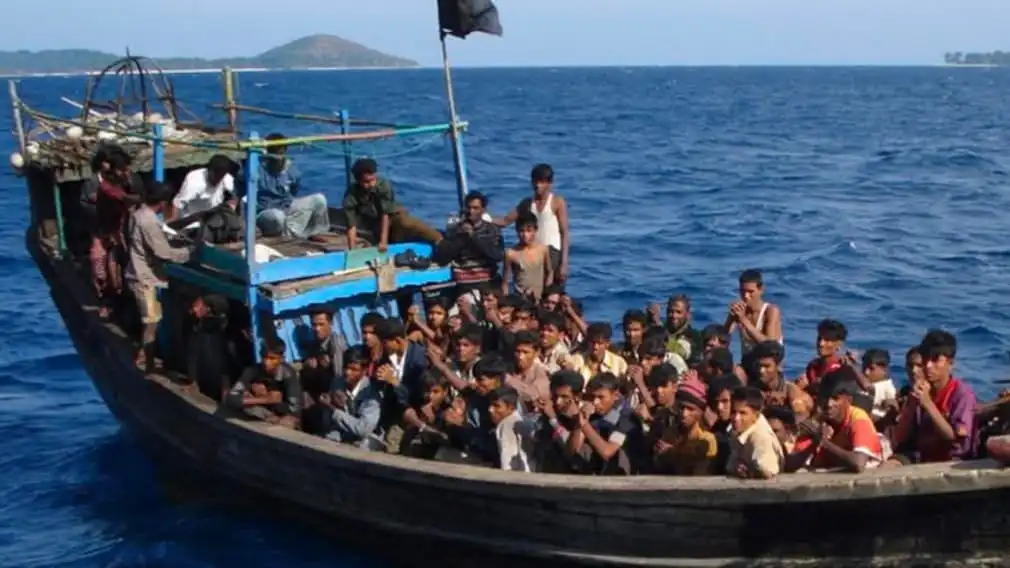
    Two boats carrying more than 500 people, most of them Rohingya, have disappeared off the coast of Myanmar, pushing the number of people reported dead or missing at sea in the region this year to more than 800, according to a detailed report published by ABC News Australia.

    The latest suspected tragedy has again exposed the conditions forcing Rohingya to undertake dangerous sea journeys: continuing persecution and armed conflict in Rakhine State, growing insecurity and declining humanitarian assistance in the refugee camps in Bangladesh, and the absence of any credible path towards a safe and dignified future.

    According to the report, based on information from the UN Refugee Agency (UNHCR), the two boats left Rakhine State in late June. Most of those on board were reportedly Rohingya, including some who had travelled from the refugee camps in Cox’s Bazar.

    One boat, believed to have been carrying approximately 250 people, lost contact shortly after leaving. A second boat, carrying an estimated 280 people, is believed to have sunk off the coast of Myanmar’s Ayeyarwady Region on July 8.

    At least five bodies were subsequently reported to have washed ashore, although it has not been established whether they were passengers from either vessel. The incidents and the number of casualties have yet to be officially confirmed.

    The two disappearances bring the number of people reported lost at sea in the region in 2026 to more than 800, approaching the record total of approximately 900 people reported dead or missing throughout 2025.

    UNHCR figures cited by ABC News show that more than one in every seven Rohingya who attempted a maritime journey last year was reported dead or missing. This was the highest mortality rate recorded on any major maritime route used by refugees and migrants worldwide.

    Passengers Reportedly Held for Months Before Departure

    The boats left during the monsoon season, when torrential rain, strong winds and large waves make the Bay of Bengal and Andaman Sea particularly dangerous. However, information gathered by the Arakan Project suggests that the passengers had not originally intended to travel during this period.

    Chris Lewa, founder and director of the Arakan Project, told ABC News that the passengers had gathered to leave in April, within the usual sailing period, but were held by people smugglers for approximately two and a half months in Thameehla village in northern Rakhine State.

    It remains unclear why the smugglers delayed the journey before sending the boats out during the monsoon.

    “These people, they were not planning to leave in the monsoon season, but they were forced to by the smuggling network,” Lewa told ABC News.

    She explained that an overcrowded wooden fishing boat could capsize within seconds if struck by a powerful wave. According to the information available to the Arakan Project, the first vessel sank at night.

    There was little confirmed information about the second boat, although fishermen reportedly saw bodies floating at sea.

    Rohingya Still Marginalised in Rakhine State

    The Rohingya are an ethnic and religious minority indigenous to Rakhine State who have faced generations of persecution in Myanmar. Although evidence of their presence in the region extends back centuries, Myanmar refuses to recognise them as one of the country’s ethnic groups and has portrayed them as illegal migrants from Bangladesh.

    Denied citizenship and subjected to severe restrictions, the Rohingya constitute the world’s largest stateless population, according to UNHCR.

    In 2017, Myanmar security forces carried out widespread killings, sexual violence and arson attacks that forced more than 750,000 Rohingya to flee to Bangladesh. Myanmar is currently facing a genocide case before the International Court of Justice over its treatment of the Rohingya. Myanmar’s military has maintained that its 2017 campaign was a counterterrorism operation.

    The situation in Rakhine State has changed considerably since the military coup of February 2021. The Arakan Army (AA) has seized control of most of the state after driving Myanmar military forces out of large areas. However, the change in territorial control has not brought security or equal rights to the Rohingya.

    Lewa told ABC News that continuing conflict, Myanmar military air strikes and the junta’s blockade have caused food and fuel shortages and disrupted telecommunications throughout Rakhine State.

    She said both Rakhine and Rohingya civilians had been subjected to conscription by the AA and forced to join labour groups. Despite the AA leadership’s public claims that communities under its rule are treated equally, Rohingya reportedly continue to face marginalisation and discrimination, including restrictions on movement, arbitrary detention and land confiscation.

    The AA has denied discriminating against the Rohingya. It has also denied allegations that its forces intentionally targeted Rohingya civilians during military operations against the Myanmar military.

    Lewa said conditions differed between areas, with some Rohingya fleeing forced recruitment and persecution under Myanmar military control while others fled conscription under the AA.

    “It’s complex,” she said. “It’s difficult for everyone, especially the Rohingya, but not only the Rohingya.”

    Insecurity and Hopelessness in the Bangladesh Camps

    Conditions are also deteriorating in the refugee camps in Cox’s Bazar, where an estimated 1.2 million Rohingya live within an area of roughly 24 square kilometres. Approximately three-quarters of the camp population are women and children.

    According to Lewa, criminal groups involved in drug trafficking, kidnapping and extortion have made the camps increasingly insecure. These groups, she said, are primarily fighting one another for control rather than acting according to any genuine political ideology.

    The camps are also highly exposed to fires, floods and landslides. Recent flooding and landslides in the Cox’s Bazar area reportedly killed at least 17 people.

    Refugees have few opportunities to work legally, pursue higher education or build independent lives. Humanitarian funding cuts have further reduced access to food and other essential services.

    “They feel helpless in the camps in Bangladesh, not being able to work, not being able to do anything, and now affected by aid cuts,” Lewa said.

    Many young people see no realistic possibility of employment, marriage, family life or personal development inside the camps. Smuggling networks exploit this absence of a future by promising work and security in countries such as Malaysia and Indonesia.

    Thirty Families Reportedly Sharing One Toilet

    Hafsar Tameesuddin, a New Zealand-based Rohingya refugee and human rights activist, visited the Cox’s Bazar camps in June. She told ABC News that she witnessed drains filled with waste running between shelters and found that as many as 30 families might be sharing one toilet that was not regularly emptied.

    Tameesuddin, who serves as co-secretary general of the Asia Pacific Refugee Rights Network, said malnutrition was widespread. Following cuts in United States humanitarian assistance, monthly food support for refugees had reportedly fallen to between $US7 and $US12 per person.

    “It’s nothing,” she said. “People can barely buy rice and chillies.”

    Children who have spent much or all of their lives in the camps have limited access to recognised education and little hope of entering meaningful employment. Tameesuddin warned that such conditions leave children and young people vulnerable to recruitment by criminal gangs and armed groups.

    During her visit, a five-year-old boy reportedly disappeared. His family paid a ransom, but his body was found one week later. Tameesuddin said incidents of kidnapping occurred frequently and that women and girls were also at risk of being trafficked into sexual exploitation.

    She said she was therefore not surprised that people continued boarding boats despite knowing that they might die during the journey.

    Some Rohingya women reportedly purchase contraceptive pills before leaving because they anticipate being raped by smugglers during the voyage.

    “Any woman, any girl, regardless of what your nationality is, knowing perfectly well that you will get raped on the boat but you’re still choosing to go — that is the explanation of how terrible and deteriorating the situation is in Cox’s Bazar,” Tameesuddin told ABC News.

    Her account demonstrates that describing these journeys simply as voluntary “choices” conceals the coercive conditions surrounding them. Rohingya passengers may physically board the boats themselves, but they do so after being denied security, citizenship, mobility, education and viable livelihoods in both Myanmar and Bangladesh.

    Calls for Search and Rescue and Regional Protection

    Following reports of the two disappearances, UNHCR and the International Organization for Migration called for stronger regional and international action to prevent further deaths on what has become one of the world’s deadliest maritime routes.

    The agencies called for improved search-and-rescue operations, access to asylum and international protection, and effective action against human-smuggling and trafficking networks.

    UNHCR spokesperson Mariko Hall told ABC News that most Rohingya still wanted to return to Myanmar if they could do so sustainably and in conditions of safety and dignity.

    “Desperation and fear for their lives are driving more and more people to attempt these dangerous sea journeys,” she said.

    Tameesuddin called on Australia to assume a stronger regional role by increasing humanitarian and development assistance for refugees in Bangladesh, particularly through Rohingya-led community organisations. She also urged Australia to engage at the regional and diplomatic levels to help create the conditions necessary for safe and dignified Rohingya repatriation.

    Australia’s Department of Foreign Affairs and Trade was contacted by ABC News but had not provided a response at the time the report was published.

    The disappearance of more than 500 people is not merely another maritime accident. It reflects the continuing failure of Myanmar, regional governments and the international community to provide the Rohingya with meaningful protection, rights or a credible future. As those conditions worsen, smugglers will continue to profit from desperation, and more Rohingya will be pushed towards journeys in which exploitation, disappearance and death have become foreseeable outcomes.


    Source link

  • Rohingya Civilian Arrested by AA Over Alleged Role in Soldiers’ Escape – Rohingya Khobor

    Rohingya Civilian Arrested by AA Over Alleged Role in Soldiers’ Escape – Rohingya Khobor


    by Hafizur Rahman

    Maungdaw, Rakhine State | July 25, 2026

    The Arakan Army (AA) has arrested a Rohingya civilian in Maungdaw Township over allegations that he helped three captured Myanmar military soldiers escape towards Bangladesh, according to local residents.

    The arrested man was identified as Mohammedura Rahman, 33, a resident of the Paungzar–Pyinphyu village tract. Residents said that around 10 AA members arrived at his home and detained him at approximately 3:40 p.m. on July 22. His current whereabouts and condition remain unknown.

    Local sources said the arrest was connected to the reported escape of three Myanmar military soldiers on July 21. The soldiers allegedly attempted to cross the Naf River into Bangladesh using yellow oil containers as flotation devices. They were subsequently detained by Border Guard Bangladesh (BGB).

    Residents, however, strongly rejected the allegation against Mohammedura Rahman. They described him as an ordinary villager with no involvement in human trafficking or assisting people in crossing the border.

    Following the incident, movement near the Bangladesh–Myanmar border has reportedly been tightened since July 22. The transportation of goods has been restricted, while local fishermen have been prohibited from going to sea.

    Residents said the restrictions have caused the prices of food and other essential commodities to rise sharply. One viss of chilli is now reportedly selling for approximately 42,000 kyats, while a bundle of betel leaves costs around 15,000 kyats and a basket of fish approximately 30,000 kyats.

    Local families fear that continued restrictions will further disrupt livelihoods and make basic food items increasingly unaffordable.


    Source link

  • THE MUSLIM COINS OF ARAKAN – Rohingya Khobor

    THE MUSLIM COINS OF ARAKAN – Rohingya Khobor


    By AFK Jilani (1940–2017)

    Coins are considered the most perfect, authentic and informative source of history. There is no doubt about the facts a coin reveals, and no one can challenge them as untrue. The value of coins as evidence of history surpasses all other sources. They are, beyond doubt, the primary and most important source for the study of history and culture.

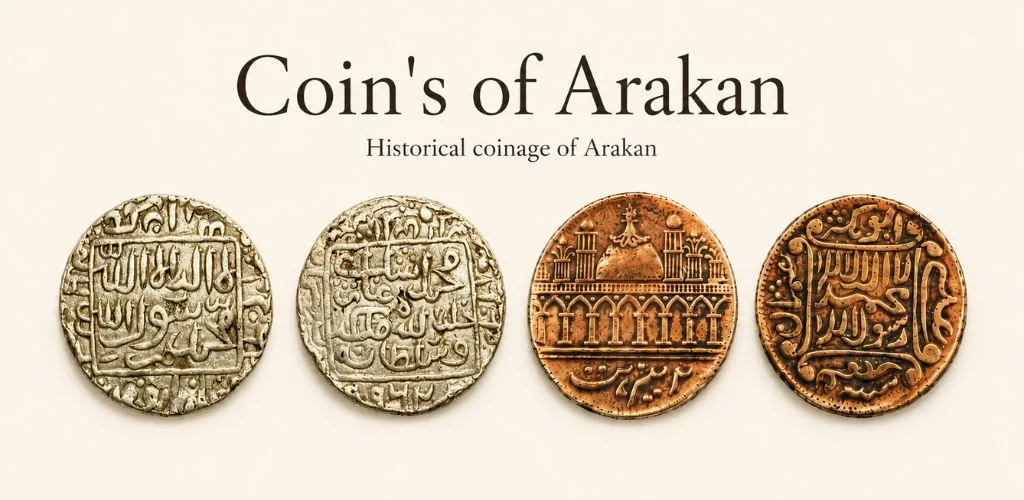
    The coins found in Arakan belonging to Wesali are Hindu, and those of Mrauk-U are Muslim. Coinage of the Muslim era is inscriptional in nature. Save for a few exceptions, it contains not a portrait or a figure but the name of the king, his title, the date and his faith. The coin’s artistic merit depends upon its calligraphy, and as anyone who has studied the Persian script as a form of mural decoration will know, this can give a remarkably balanced and vital impression of art.

    According to M.S. Collis, Mr Htoon Aung Gyaw, Barrister-at-Law, and certain other private collectors of Akyab have in their possession over a hundred coins found in Arakan. When recently arranged by Mr San Shwe Bu, many of them were seen to be duplicates, but sixteen belonging to the Mrauk-U dynasty (1430 to 1784 A.D.) were distinct specimens, bearing the dates and titles of fifteen different kings of that line. There were also a few coins belonging to the Wesali dynasty (788 to 951 A.D.).

    The Burmese invaded Arakan in 1406. Min Saw Mwan, the king of Arakan, fled the country, taking refuge at Gaur, the capital of the Sultan of Bengal. The Arakanese king remained there for twenty-four years. In 1430 the Sultan of Bengal restored him to the throne of Arakan as his tributary. He turned away from what was Buddhist and familiar to what was Muslim. In so doing he moved from the mediaeval to the modern, from the fragile fairyland of the Glass Palace Chronicle to the robust extravagance of the Thousand and One Nights.

    Jalaluddin Mohammed Shah restored him in 1430 A.D., and Mrauk-U was built. It is noteworthy that one of Nasiruddin’s coins was recently found near the site of that city — a unique document in the history of Arakan. When the Muslims entered Bengal in 1203, they introduced the inscriptional type of coinage, and it was in that tradition that the coinage of Mrauk-U was subsequently modelled. In this way Arakan became definitively oriented towards the Muslim states. Contact with a modern civilisation brought about a renaissance, and the country’s great age began.

    Shin Arahan would have found himself as out of place at the court of Gaur as St. Bernard at the University of Cordova. To avoid such a dislocation and to seize the advantage offered by change, the Arakanese had to set aside a fashion in ideas that had fallen behind the march of the world’s thought, and bring themselves up to date. It took the Arakanese a hundred years to learn that lesson from the Muslims.

    In 1531 Minbin Zabauk Shah ascended the throne. With him the Arakanese came of age in their Islamic studies, and the Arakanese Empire was founded. Among Mr Htoon Aung Gyaw’s collection is one of Minbin’s coins. It offers a succinct commentary on Arakan’s sudden rise to importance in the Bay of Bengal: on one side is inscribed the word “Minbin” in Burmese characters, and on the reverse, in Nagari, his Muslim title, Zabauk Shah. Arakan had by then turned into a Sultanate.

    For a short period during the reign of Razagri Salim Shah, Arakan extended from Dacca and the Sundarbans to Moulmein — a coastal strip a thousand miles long and varying from 20 to 150 miles in breadth. In imitation of the imperial court of Delhi, its kings adopted the title of Padshah. This was the moment of Arakan’s highest destiny.

    The coins of the Sultans were inscribed with precise and elegant Persian lettering. Under Akbar and his successors, the script became a fine art — imperially cursive, whirling under the eye, possessing a living beauty. M.S. Collis and San Shwe Bu possessed a coin of Razagri Salim Shah: on the obverse his title in Burmese, on the reverse in Persian and Nagari. The style is essentially that of the Sultanates, and is further evidence of Arakan’s advancement.

    One coin of Sultan Ali Shah (Thatasa, 1525 C.E.), found recently at Mrauk-U, is inscribed in Persian: “There is no God but Allah, Mohammed the Messenger of Allah. May Allah perpetuate his kingdom.” The reverse, also in Persian, reads: “Sultan Ali Shah, father of the victorious. May Allah perpetuate his kingdom.” A coin of Razagri/Salim Shah (1593–1612) is also held in the collection of the Chittagong University Museum. Dr. A. Karim remarks that the coin of Salim Shah is of particular interest, throwing light on Arakan’s relations with Bengal.

    Another Muslim coin of Arakan, minted between 1430 and 1530 A.D., bears a mural decoration of a mosque alongside a Persian inscription of fine artistry — invaluable to the cultural history of Arakan and its civilization. Its reverse is inspirational in nature, containing the Kalima (the profession of faith in Islam) and the names of Islam’s four Khalifas — Abu Bakar (R.A.), Umar (R.A.), Osman (R.A.) and Ali (R.A.) — carefully recorded with artistic merit.

    Of the last seven kings of Arakan, all have coins except numbers 42 and 46, who each ruled only a few weeks. The coins themselves exhibit little variation, remaining within the Muslim tradition. The Burmese, by contrast, never had a coinage of their own while it flourished in Arakan. It is therefore clear that the Muslims and Rakhine of Arakan were, culturally and economically, and in the governance of the state, considerably more advanced than the Burmese of that era.

    After the occupation of Arakan, King Bodaw’s first act was to strike a medallion in the style of the Mrauk-U coinage. Having no tradition of minting coins of his own, he simply copied the Muslim design. The legend reads: “The Kingdom of the Master of Amarapura and of many white elephants.” This is the numismatic record of the fall of Mrauk-U — the last coin struck in Arakan, and the first time in its long history that Arakan had lost a home government of its own.

    What is more important is that Manrique, who witnessed the coronation of King Thiri Thudamma Salim Shah II, used only the Muslim name Salim Shah; he did not use the Magh name of the king. There is no doubt, then, that the Arakanese kings took Muslim names deliberately and purposely, and that not only one king but all those who reigned for more than two hundred years used Muslim names and inscribed them on their coins. So A.P. Phayre is wrong when he says that the Arakanese kings made “barbarous imitations” and adopted “fanciful designations.”

    As one writer notes: “In striking the coins, the policy of inscribing the Islamic creed (Kalima) and the Muslim names of their kings in Persian characters was followed, and because Muslim ministers were appointed in the court of the Arakanese kings, modern Arakanese Rohingya Muslims believe for certain that those Arakanese kings were Muslims.” Another writer states that the Arakanese kings considered it a point of honour to inscribe Muslim names and the Muslim creed (Kalima) on their coins alongside their Magh names. There is no evidence that they were not Muslims. We can call them Rohingyas, as they were the kings of Rohang.

    AFK Jilani was a Rohingya writer, historian and community leader from Maungdaw, and a former Senior Vice President of the Arakan Rohingya National Organisation (ARNO). He authored several works on Rohingya history and culture, including The Rohingyas of Arakan: Their Quest for Justice and A Cultural History of Rohingyas. Rohingya Khobor republishes this article in tribute to his legacy.


    Source link

  • Bangladesh and China Discuss Rohingya Repatriation and Expanded Bilateral Cooperation – Rohingya Khobor

    Bangladesh and China Discuss Rohingya Repatriation and Expanded Bilateral Cooperation – Rohingya Khobor


    by RK Desk

    Manila, Philippines | July 22, 2026

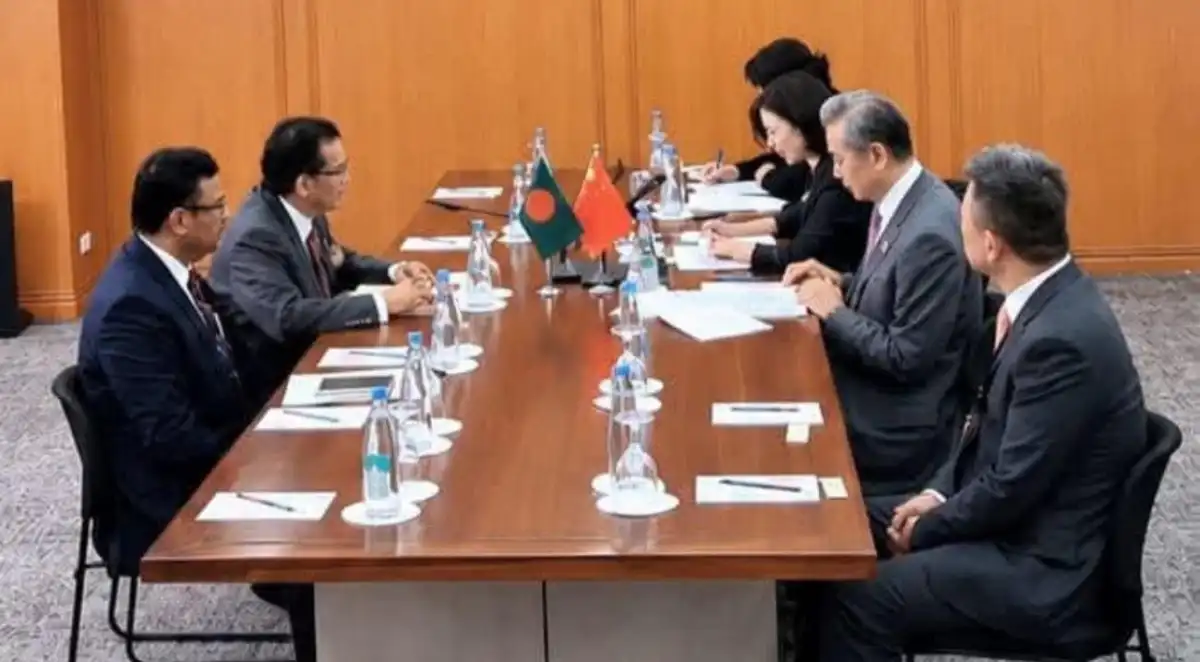
    Bangladesh and China have discussed Rohingya repatriation and ways to strengthen bilateral cooperation in transport, investment, energy, and economic development.

    The discussions took place on Wednesday in Manila, the capital of the Philippines, on the sidelines of the ASEAN Foreign Ministers’ Meetings and related events.

    Bangladesh was represented by Foreign Affairs Adviser Khalilur Rahman and Prime Minister’s High Representative for the Rohingya Issue and Priority Matters M. Humayun Kabir, who met with Chinese Foreign Minister Wang Yi.

    During the meeting, both sides discussed further strengthening the long-standing partnership between Bangladesh and China. They also exchanged views on supporting the safe, voluntary, and sustainable repatriation of Rohingya refugees to Myanmar.

    The two countries also discussed enhancing regional transport connectivity, increasing Chinese investment in Bangladesh, expanding energy cooperation, and promoting broader economic development.

    The meeting reflected the continued efforts of Bangladesh and China to work together on regional issues, including advancing a durable solution to the Rohingya crisis while deepening bilateral economic and development cooperation.


    Source link

  • Bangladesh Calls for Stronger BIMSTEC Action on Rohingya Crisis – Rohingya Khobor

    Bangladesh Calls for Stronger BIMSTEC Action on Rohingya Crisis – Rohingya Khobor


    by RK Desk

    Dhaka | July 20, 2026

    Bangladesh has called on member states of the Bay of Bengal Initiative for Multi-Sectoral Technical and Economic Cooperation (BIMSTEC) to play a stronger role in increasing international pressure on Myanmar to help achieve a lasting solution to the Rohingya crisis.

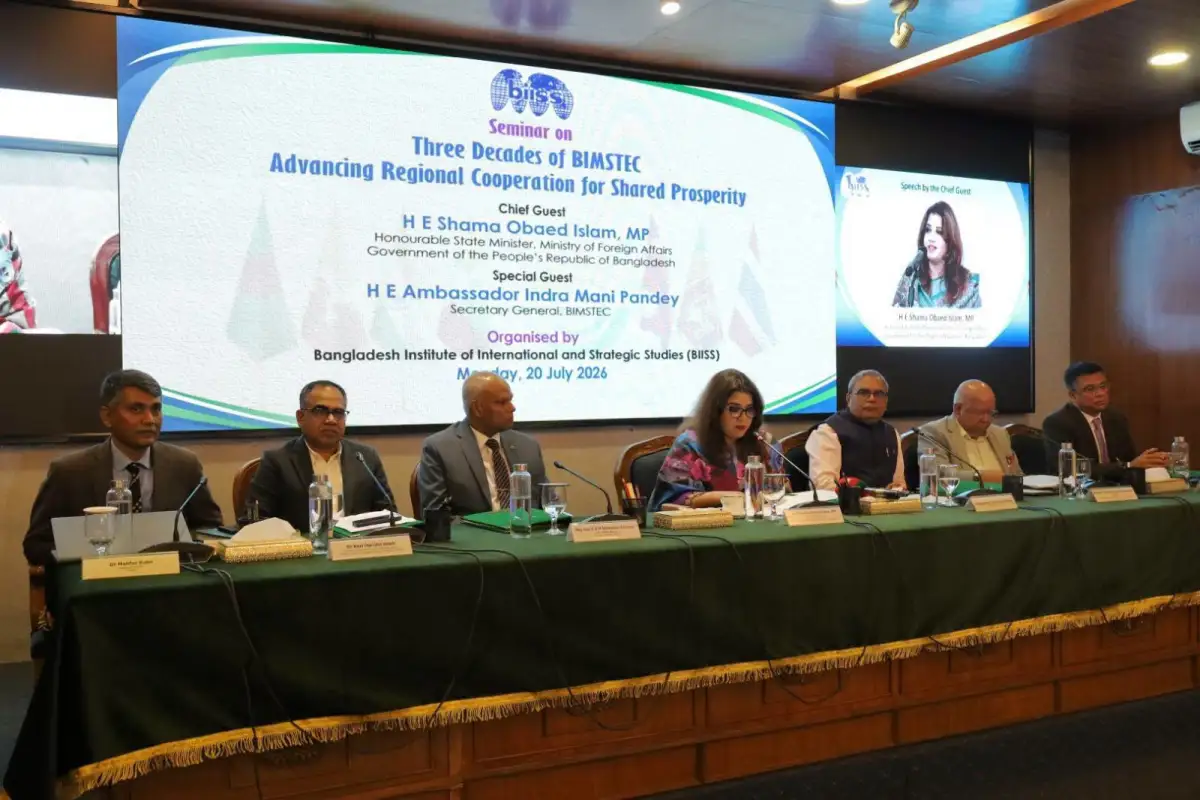
    State Minister for Foreign Affairs Shama Obaed Islam made the call while speaking at a seminar titled “Three Decades of BIMSTEC: Advancing Regional Cooperation for Shared Prosperity,” held at the Bangladesh Institute of International and Strategic Studies (BIISS) in Dhaka.

    She said the international community must continue exerting pressure on Myanmar to create conditions for the safe, voluntary, and sustainable return of Rohingya refugees to their homeland. She added that BIMSTEC member states can make an important contribution by working together toward that goal.

    The minister also reaffirmed Bangladesh’s commitment to strengthening BIMSTEC and promoting peace, cooperation, and sustainable development across the Bay of Bengal region. She said regional commitments must be translated into concrete action through closer cooperation and more effective implementation.

    As the current Chair of BIMSTEC, Bangladesh will continue to promote regional connectivity, trade, investment, the Blue Economy, and people-centered cooperation across the region, she said.

    BIMSTEC Secretary General Ambassador Indra Mani Pandey highlighted the organization’s ongoing work in areas including women’s empowerment, climate adaptation, energy cooperation, drug control, cybersecurity, maritime security, counterterrorism, tourism, visa facilitation, trade, and investment.

    The seminar also featured presentations and discussions by researchers and policy experts reviewing BIMSTEC’s progress over the past three decades. Participants explored ways to strengthen the organization, improve regional connectivity, expand economic cooperation, and promote peace, stability, and sustainable development.

    Participants also emphasized the need for stronger practical cooperation and closer partnerships among BIMSTEC member states to better address shared regional challenges, including the Rohingya crisis.


    Source link

  • Myanmar Junta Carries Out Another Airstrike in Minbya Township – Rohingya Khobor

    Myanmar Junta Carries Out Another Airstrike in Minbya Township – Rohingya Khobor


    by Hafizur Rahman

    Minbya Township, Rakhine State | July 20, 2026

    The Myanmar junta reportedly carried out another airstrike in Minbya Township on the evening of July 20, marking the latest in a series of aerial attacks across Rakhine State.

    According to local sources, the airstrike targeted the area around the former No. 9 Central Training Ground near Kamni Village at approximately 7:15 p.m.

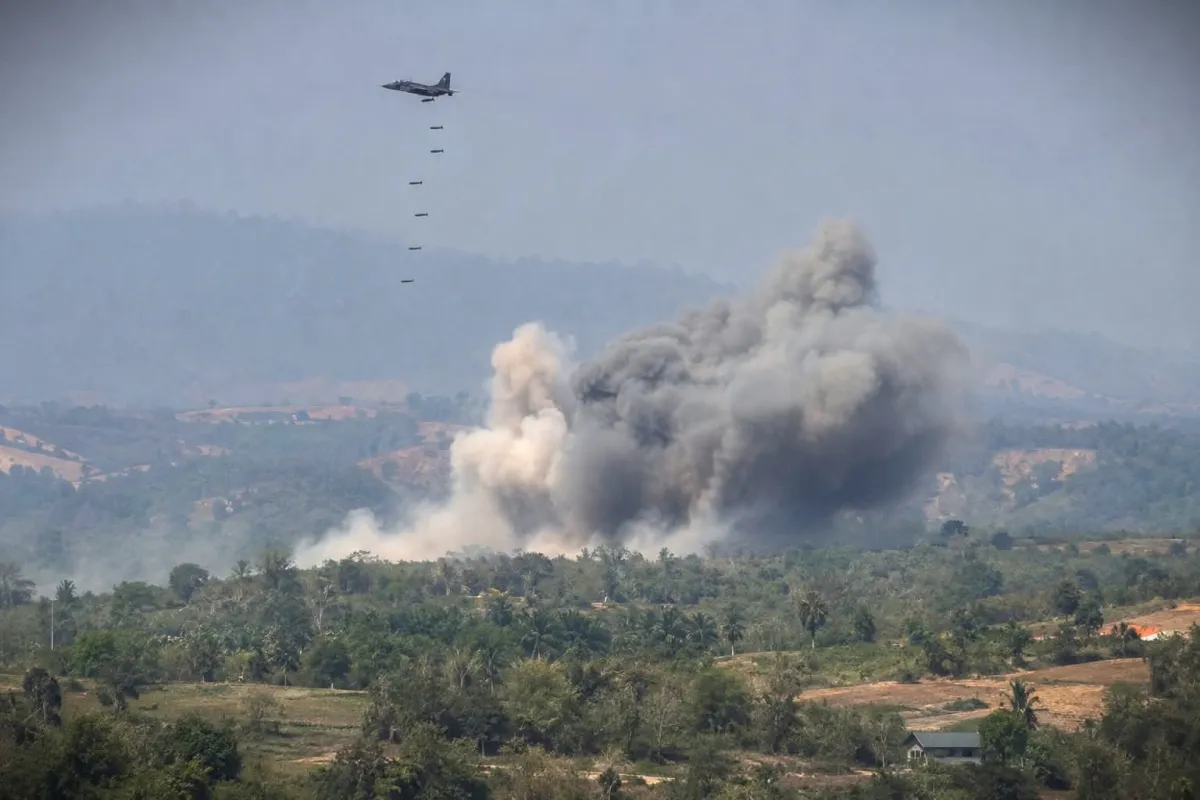
    Residents said they saw a fighter jet circling overhead before bombs were dropped. At least three explosions were heard during the attack. Information on casualties or damage was not immediately available.

    Earlier the same day, the junta reportedly launched heavy airstrikes near Kyauk Kyat and Kyauk Se Pyin villages in Mrauk-U Township. Local reports said seven fighter jets dropped around 100 bombs in eight waves of airstrikes, spreading fear among nearby communities.

    A Rohingya resident told Rohingya Khobor, “We heard the jet circling above the villages before the explosions. Everyone became frightened because we had no idea where the bombs would fall.”

    Another Rohingya resident said, “The bombing did not stop after the first explosion. We kept hearing more blasts and worried that our villages could be next.”

    A third Rohingya villager told Rohingya Khobor, “People grabbed their children and ran for safety. The sound of the bombs was terrifying, and everyone was in panic.”

    The full extent of the damage from both airstrikes remains unclear. Local residents say they continue to fear further aerial attacks as the security situation across Rakhine State remains highly volatile.


    Source link

  • Global Refugee Crisis Deepens as Bangladesh Faces Growing Rohingya Challenges – Rohingya Khobor

    Global Refugee Crisis Deepens as Bangladesh Faces Growing Rohingya Challenges – Rohingya Khobor


    by RK Desk

    July 19, 2026

    The global refugee crisis continues to deepen, with millions of people forced to flee their homes because of war, violence, and persecution. According to the UN Refugee Agency (UNHCR), the number of refugees worldwide reached 41.6 million by the end of 2025, while the total number of forcibly displaced people rose to 117.8 million.

    This year marks the 75th anniversary of the 1951 Refugee Convention, which established the international framework for protecting refugees and calls on states to ensure access to safety, shelter, healthcare, education, livelihoods, and the opportunity to rebuild their lives with dignity.

    Despite these commitments, most refugees continue to be hosted by low- and middle-income countries, while many wealthier nations have tightened border controls and offered limited opportunities for refugee resettlement. As a result, countries such as Bangladesh continue to shoulder a disproportionate share of the global refugee response.

    Bangladesh currently hosts more than 1.19 million Rohingya refugees, including those who arrived during the refugee influxes of the 1990s. Over the past year and a half, more than 152,000 additional Rohingya have crossed into Bangladesh after fleeing renewed violence and insecurity in Myanmar.

    Nine years after the mass exodus of 2017, no large-scale voluntary repatriation has taken place. Bangladesh continues to provide shelter and basic humanitarian services to Rohingya refugees despite not being a signatory to the 1951 Refugee Convention.

    Funding remains one of the most pressing challenges. International support for the Rohingya response has declined in recent years. In 2025, humanitarian agencies received only 38 percent of the funding required for the response. Although funding has improved in 2026, it still covers only about 60 percent of identified needs, limiting the provision of education, healthcare, shelter, food assistance, and other essential services in the camps.

    The continued arrival of new refugees has also placed additional pressure on Bangladesh. Authorities are considering stronger border management measures while continuing to respond to urgent humanitarian needs.

    Many analysts argue that the Rohingya crisis is not only a humanitarian emergency but also a political one. They say a durable solution will remain out of reach without stronger international engagement and sustained pressure on Myanmar to create conditions for the safe, voluntary, and dignified return of Rohingya refugees.

    There are also ongoing discussions about a proposed Bangladesh–China–Myanmar Economic Corridor. Some observers believe the initiative could strengthen Bangladesh’s leverage in future discussions on Rohingya repatriation, although its potential impact will depend on broader regional political and security developments.

    Meanwhile, more than a million Rohingya continue to live in overcrowded refugee camps with limited educational and livelihood opportunities. Aid agencies warn that persistent funding shortfalls could further weaken essential humanitarian services, leaving many families increasingly vulnerable.

    Humanitarian organizations continue to call for greater international solidarity, increased financial support, and renewed diplomatic efforts to help secure a safe, voluntary, dignified, and sustainable solution to the Rohingya crisis.


    Source link

  • Rohingya Muslim Members of Arakan Army Reportedly Join Flood Relief Efforts in Buthidaung – Rohingya Khobor

    Rohingya Muslim Members of Arakan Army Reportedly Join Flood Relief Efforts in Buthidaung – Rohingya Khobor


    by Hafizur Rahman

    Buthidaung, Arakan State | July 17, 2026

    The United League of Arakan/Arakan Army (ULA/AA) has reportedly continued providing food and emergency assistance to communities affected by flooding in Buthidaung Township, Arakan State.

    Heavy rainfall that began on July 1 caused flooding across at least eight townships, including Buthidaung, affecting numerous villages and forcing some residents to leave their homes.

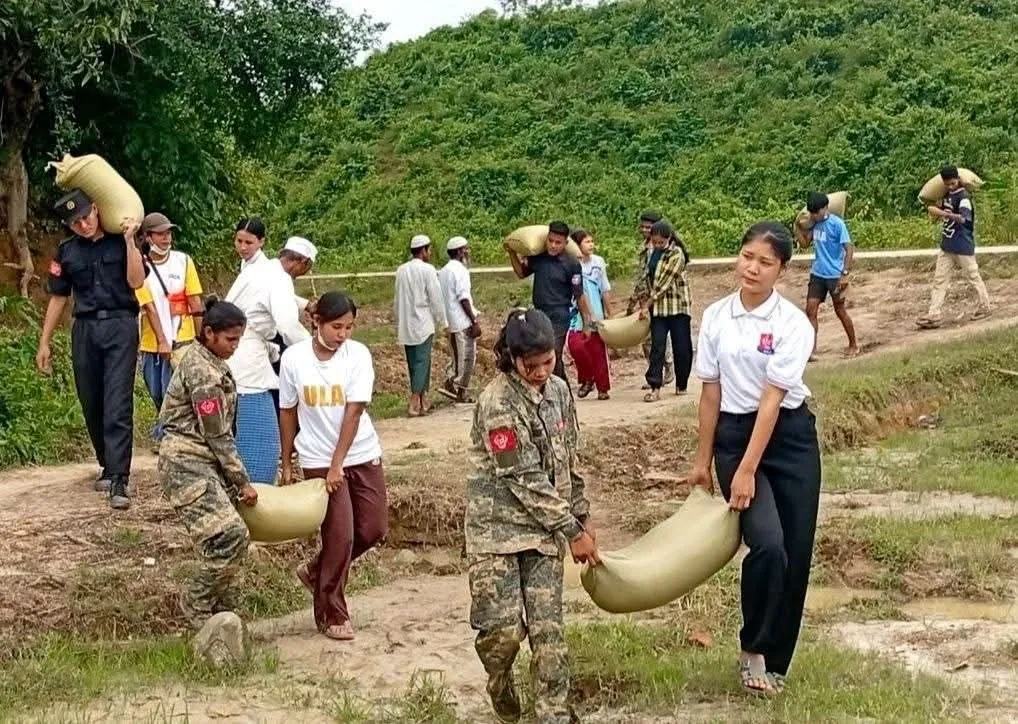
    According to the report, the ULA/AA carried out emergency evacuations and distributed rice and other essential food supplies to flood-affected communities.

    On July 15, relief assistance was reportedly delivered to several villages, including Than Chwe (Zay Tan), Thabyuchaung (Muslim Village), Sin Oe Pyin (Muslim Village), Shwe Oe Pyin, and Deli (Muslim Village).

    A local source also told Rohingya Khobor that on July 17, the AA distributed 20 kilograms of rice to each family in Ton Bai Village, Kenothi Village, and Mee Gyi Jee Village in Buthidaung Township.

    The report also stated that ULA/AA members worked alongside local residents to remove mud and debris left behind by the floodwaters in Buthidaung town.

    It further said that Rohingya Muslim men and women serving in the Arakan Army participated in rescue, relief, and cleanup operations alongside other AA members.

    According to the report, relief operations—including food distribution, emergency assistance, healthcare services, and cleanup activities—are continuing across flood-affected areas as communities recover from the disaster.


    Source link